

Offer actionable threat intelligence to mitigate risks associated with compromised credentials.
Contact Us
Get this feature up and running in days.

Just $0.005 at each login.

Your competitors are already adopting this feature. Ensure you don’t lose market share or revenue.
OVERVIEW
Enhance product differentiation with an innovative, high-value feature that encourages action and generate additional revenue from premium customers with minimal development effort.
Enzoic Credentials SDK checks for full credentials, which is the username with the password, for compromise at every login and password change.
HOW IT WORKS
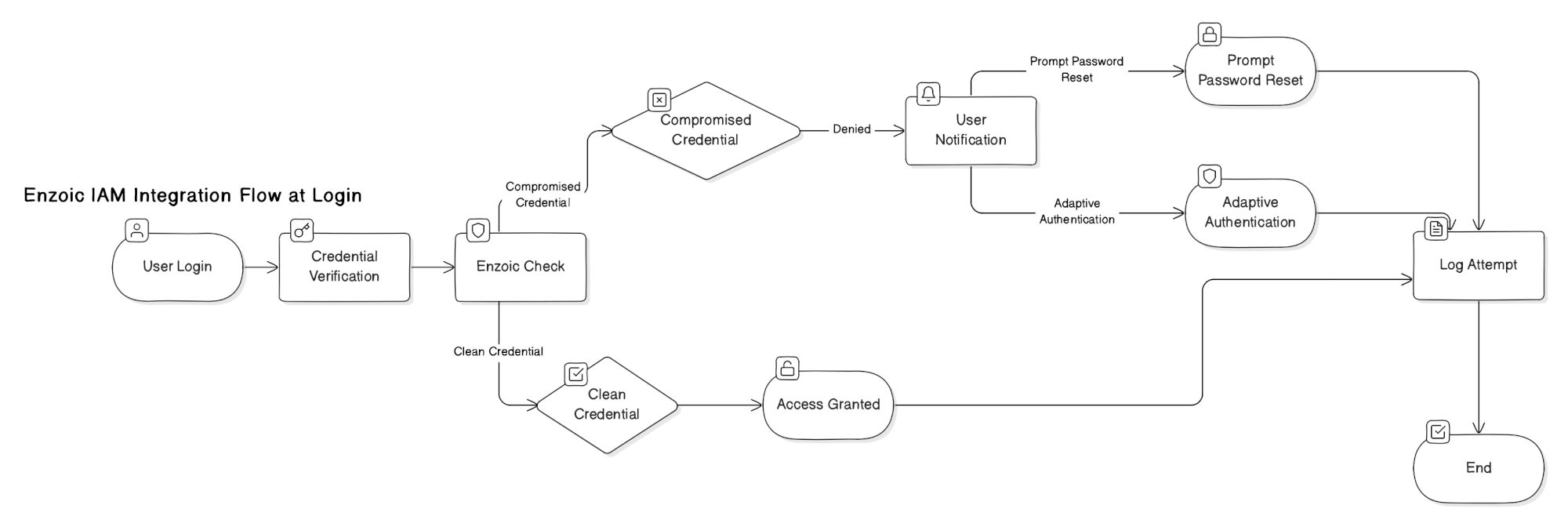
When an end user attempts to authenticate through the IAM platform, their credentials (username and password) are securely sent to Enzoic for verification. Enzoic checks these credentials against its database of compromised credentials. If the credentials are safe, authentication proceeds as normal. However, if Enzoic finds that the credentials have been compromised, it notifies the IAM platform. The IAM platform can then deny authentication and inform the user of the compromise, prompting them to reset their password. Many of your IAM competitors are already implementing this feature, so it’s essential to include it to keep your product competitive.
USE CASE
Proactively prevent the use of compromised credentials. The integration leverages Enzoic’s robust database of credentials compromised in data breaches, the dark web, and other sources, enabling real-time password verification.
The process initiates when an end user logs into a corporate application via the IAM platform, which sends the credentials to Enzoic for verification. Based on Enzoic’s response—clean or compromised—the platform either authenticates the user or denies access and prompts for a password reset. In scenarios such as new account setups or password resets, Enzoic detects compromised credentials, prompting the user to select a secure alternative.
The integration ensures all authentication activities are logged for compliance, operates under secure API communications, and assumes end users are educated about the importance of strong password hygiene. This setup enhances the IAM platform’s capability to mitigate risks associated with credential compromise, aligning with advanced security protocols.
Sample of how it works: https://demo.enzoic.com/
Credential screening in an IAM platform is the process of checking passwords or username/password combinations against known exposed or compromised credentials from data breaches, infostealer malware, and dark web sources.
This helps identify credentials that may already be at risk of misuse. Solutions like Enzoic enable this screening to occur in real time during login, password reset, or account creation, allowing organizations to block compromised credentials before access is granted.
Enzoic is designed for fast, low-friction integration into existing IAM environments.
Because Enzoic integrates directly into existing authentication workflows, organizations can add credential screening without rearchitecting their IAM platform or impacting user experience.
No. Enzoic does not store or retain users’ plaintext passwords during credential checks.
All verification is performed using a privacy-preserving architecture, where credentials are processed securely but not persisted, ensuring sensitive login data remains protected and under your control.
Enzoic uses a secure partial-hash matching approach:
All processing happens over encrypted connections and in memory, so credentials are never stored.
Credential stuffing attacks use stolen username/password combinations from previous breaches to gain unauthorized access.
Because many users reuse passwords across systems, these attacks often succeed—even when password complexity requirements are in place. This makes credential-based attacks one of the most effective ways to bypass traditional IAM controls.
Enzoic mitigates this risk by detecting exposed credentials before authentication succeeds, preventing attackers from logging in with valid but compromised credentials.
Yes. National Institute of Standards and Technology NIST SP 800-63B recommends screening new passwords against lists of commonly used, expected, or compromised values.
Enzoic supports this guidance by continuously checking passwords against a large, frequently updated database of exposed credentials and preventing the use of known breached passwords.
Blog
Identity and Access Management has a Password Problem. Read the blog and full report from EMA: Contextual Awareness: Advancing IAM to the Next Level.
Blog
Multi-factor authentication (MFA) is useful, but not a failsafe strategy for user authentication. Read to learn more.
Blog
The Google Threat Horizons report found that cloud computing services are facing increasing threats of compromise and abuse.
Give your customers additional security without impacting user experience.
Contact Us