

Organizations often measure a breach by how many records were exposed. Attackers measure it by something far simpler: how many credentials still work.
For years, the cybersecurity industry has associated larger breaches with greater risk. Headlines focus on hundreds of millions of exposed records, reinforcing the idea that bigger breaches automatically create bigger security problems.
For cybercriminals, however, the size of a breach is only part of the equation. Freshness, validity, and context often matter just as much.
The ultimate objective isn’t collecting usernames and passwords—it’s using them. A database containing millions of active credentials can be far more valuable than a much larger collection of outdated or heavily recycled passwords because active credentials create opportunities for immediate access.
That distinction is becoming increasingly important as credential-based attacks continue to evolve.
Today’s threat landscape isn’t defined by a shortage of stolen credentials. Cybercriminals already have access to enormous collections of usernames and passwords gathered from years of breaches, credential dumps, and underground marketplaces. Yet attackers continue investing significant effort into acquiring newly exposed credentials because they offer something older datasets often cannot: a greater likelihood of successful authentication before passwords are reset, accounts are disabled, or security teams can respond.
This shift helps explain several trends shaping modern credential attacks. Newly compromised organizational data has become increasingly valuable because it often contains current usernames and passwords tied to active users. Infostealer malware continuously harvests credentials directly from infected endpoints instead of relying only on public breach disclosures or centralized database compromises. Even password storage practices influence how quickly attackers can turn exposed credentials into unauthorized access.
Viewed together, these trends reveal a broader shift in how attackers approach credential theft.
The value of a stolen credential is no longer measured simply by whether it appears in a breach. It’s measured by whether it still provides access.
Organizations often think about compromised credentials as one enormous pool of stolen usernames and passwords. In reality, not every credential has the same value to an attacker.
Older credential collections continue to circulate across criminal forums and underground marketplaces, but many of those credentials have already been exposed multiple times. Users reset passwords, organizations disable accounts, and security teams remediate compromised credentials as incidents are discovered. While older credential datasets can still support password spraying and credential stuffing attacks, they also contain significant amounts of duplicate, recycled, or outdated information.
Newly compromised credentials are different.
Rather than representing years of aggregated breach data, recently exposed organizational credentials are more likely to belong to active users and current accounts, especially when they come from recent breach data or infostealer logs. They also tend to be tied to identifiable organizations, giving attackers an immediate opportunity to target specific employees, customers, or business systems before widespread remediation occurs.
For attackers, that’s a far more valuable outcome than simply adding another massive credential list to an already crowded collection.
Successful credential attacks aren’t measured by how many passwords are stolen. They’re measured by how many usernames and passwords still authenticate.
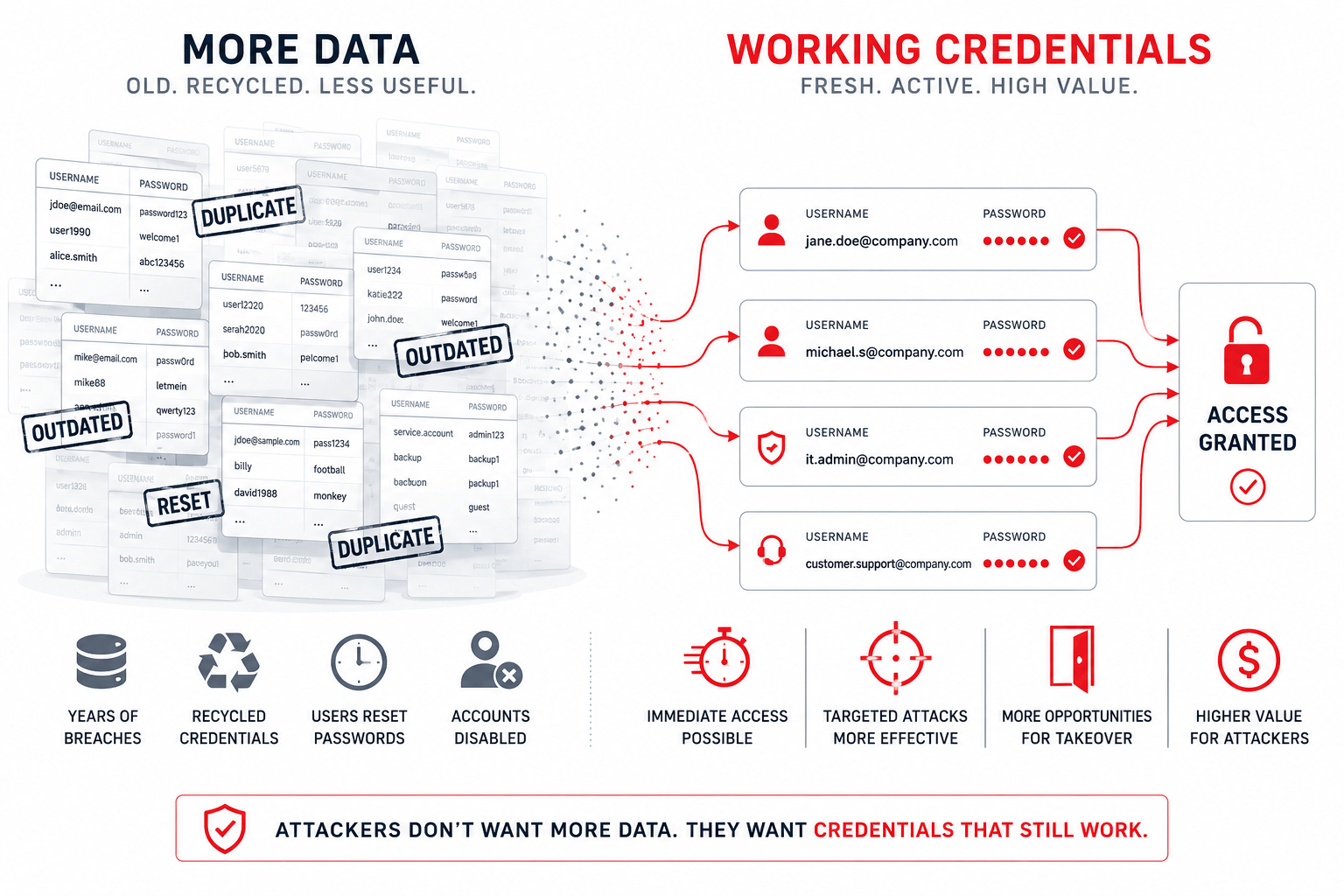 Attackers prioritize exposed credentials that are most likely to result in successful authentication.
For years, organizations associated credential exposure with a major breach. An attacker compromised a database, stole usernames and passwords, and eventually the incident became public. Security teams reset passwords, notified users, and worked to contain the damage.
That model still exists, but it is no longer the only—or even the fastest—way credentials become compromised.
Infostealer malware has materially changed how cybercriminals acquire credentials. Rather than relying on centralized database breaches, infostealers can target individual devices, harvesting credentials directly from browsers, applications, password stores, and other local sources. Browser-stored usernames and passwords, session cookies, tokens, and other authentication data can all be collected from an infected endpoint, often without the user realizing anything has happened.
For attackers, this offers a significant advantage.
Rather than waiting for a large organization to be compromised, they can continuously collect credentials from thousands of individuals. Every device becomes another source of recently exposed usernames and passwords that may still provide access to corporate applications and business systems.
This helps explain why credential theft has become increasingly industrialized. Instead of relying solely on occasional high-profile breaches, attackers now have a continuous pipeline of newly exposed credentials entering criminal marketplaces.
The result isn’t necessarily more credentials—it’s more usable credentials. Fresh credentials give attackers a greater opportunity to authenticate before organizations recognize the exposure and respond.
Unlike credentials that may have circulated for years, browser-stored passwords harvested from infected endpoints are more likely to belong to current users with active accounts. Organizations may not yet know those credentials have been exposed, giving attackers an opportunity to attempt authentication before passwords are changed or accounts are secured.
This shift has important implications for defenders.
Credential exposure is no longer limited to breach notifications or publicly disclosed incidents. Credentials can be compromised through malware infections affecting employees, contractors, or consumers long before an organization becomes aware that those usernames and passwords are at risk.
For organizations focused on preventing account takeover, this reinforces an important point: protecting credentials doesn’t end with creating strong passwords. It also requires understanding when legitimate credentials have already been exposed through sources outside an organization’s direct control.
The faster attackers can obtain working credentials, the less time organizations have to respond. That makes continuous visibility into credential exposure just as important as the policies used to create those credentials in the first place.
Historically, compromised credentials often meant a username and password. Those combinations were valuable for password reuse and credential stuffing attacks, but they often lacked context.
Today’s credential exposures are often richer and more contextual.
Recently compromised datasets increasingly include supporting account information alongside usernames and passwords. Email addresses, phone numbers, usernames, login URLs, domains, session cookies, device information, and other identifying details often accompany exposed credentials, giving attackers additional ways to validate accounts and improve the success of credential-based attacks.
That additional context it amplifies the value of the exposure.
A login URL or corporate email domain can help identify the organization, application, or authentication system associated with a credential. A phone number may help attackers craft convincing SMS phishing campaigns or abuse account recovery workflows. Usernames can help distinguish between personal and corporate accounts, making credential reuse attacks more targeted and efficient.
For attackers, every additional piece of information increases confidence that a stolen credential belongs to a real, active user.
This evolution also helps explain why recently compromised organizational data has become increasingly attractive. Rather than exposing isolated username-password pairs, newer datasets often provide enough context to make credential attacks more precise. Instead of launching broad, indiscriminate credential stuffing campaigns, attackers can prioritize high-value accounts and tailor their approach to the organization they’re targeting.
The credential remains the objective.
The surrounding information simply increases the likelihood that the credential can be used successfully.
For defenders, understanding that a username and password have been compromised is critical but understanding the context surrounding that exposure helps organizations better assess the potential risk and prioritize remediation.
Ultimately, attackers are still pursuing the same outcome they’ve always wanted—successful authentication. Richer credential datasets simply make achieving that outcome easier.
Organizations have spent years improving password security—and for good reason. Eliminating weak, predictable, commonly used passwords remains a starting point to manage the risk of credential-based attacks. Longer passwords, banned password lists, and modern password policies all make it more difficult for attackers to guess or crack credentials.
Those controls are still essential.
But they address only one side of the credential security equation.
A strong password can still become a compromised password.
Recent breach data continues to show that exposed credentials are not always protected equally. Some passwords are still discovered in plaintext, allowing attackers to use them immediately. Others are protected with outdated or weak hashing algorithms that significantly reduce the effort required to recover the original password. While modern hashing standards have improved password security, legacy systems and older applications continue to expose credentials in ways that attackers can exploit.
Infostealer malware harvests usernames and passwords directly from endpoints and browser stores, often after users have saved or entered them,, bypassing many of the protections designed to secure password databases. From the attacker’s perspective, it makes little difference whether a password was stored with a modern hashing algorithm if it has already been captured in usable form from an employee’s device.
This highlights an important shift in credential security.
Password strength and credential exposure are not the same problem.
Password policies determine which passwords users create. Credential monitoring helps organizations determine whether those passwords have already been compromised or will become compromised later.
Both are necessary.
Organizations cannot rely solely on stronger password requirements while assuming exposed credentials will eventually be discovered through incident response or breach notifications. By the time many exposures become public, attackers may have already attempted to use those credentials.
Modern credential security requires organizations to address the entire lifecycle of a password—from creation and storage to continuous monitoring for exposure. Reducing credential risk is no longer just about preventing weak passwords. It’s also about identifying compromised credentials before attackers can turn them into successful logins.
Organizations have made significant progress in strengthening password security over the past decade. Password guidance has shifted away from rigid composition rules and toward longer passwords, compromised-password screening, and user-friendly controls that make secure choices easier to maintain.
Those improvements have technically made it harder for attackers to guess credentials.
They haven’t changed the fact that attackers continue to steal them.
That distinction is becoming one of the defining challenges in modern credential security. Organizations can enforce strong password policies and educate users about credential hygiene, yet still find themselves responding to account takeover because legitimate credentials were exposed elsewhere.
The objective, therefore, is no longer just to create stronger passwords. It is to reduce the time between credential exposure and remediation.
That requires a shift in thinking.
Organizations also need continuous visibility into whether employee and customer credentials have appeared in breach data, malware campaigns, or other sources of exposure. The faster compromised credentials are identified, the faster organizations can reset passwords, protect accounts, and reduce the opportunities attackers depend on.
Cybercriminals don’t need another billion usernames and passwords.
They need credentials that still work.
Organizations that recognize that distinction—and continuously monitor for credential exposure rather than relying solely on password policies—will be better positioned to stop account takeover before legitimate credentials become an attacker’s easiest path into the business. By combining compromised-password screening, continuous credential monitoring, and automated remediation, organizations can shrink the window between exposure and response, making stolen credentials far less useful to attackers.