

Organizations are investing more in identity security than ever before, yet credential-based attacks continue to succeed. Rather than relying solely on malware or software exploits, attackers are increasingly using legitimate credentials stolen through data breaches, infostealer malware, password reuse, and credential stuffing. When a login uses a valid username and password, it can be difficult to distinguish malicious activity from legitimate user behavior.
This shift has changed the role of identity and access management (IAM). Traditional identity controls remain essential, but they were largely designed to verify identity and enforce password policy—not determine whether those credentials have already been exposed to attackers.
To help organizations better understand this evolving threat landscape, we recently published Identity-First Threat Intelligence: Harnessing Dark Web Signals to Strengthen IAM and AD Security. The guide examines how credential theft has evolved, why traditional identity protections struggle to keep pace, and how organizations can strengthen Active Directory and modern authentication environments with continuous identity threat intelligence.
This article highlights several of the key concepts explored throughout the ebook.
For years, enterprise security focused on protecting the network perimeter. Firewalls, VPNs, endpoint protection, and intrusion prevention systems were designed to keep attackers outside the organization.
That model has fundamentally changed.
Today’s attackers often don’t need to exploit a vulnerability or deploy malware inside a network. Instead, they log in using credentials that have already been compromised. Recent industry reports continue to show that the use of stolen credentials remains one of the most common techniques used in cyberattacks, while identity abuse appears across a significant percentage of modern breaches. Recent industry research highlights the continued risk of stolen credentials, with Verizon’s 2026 DBIR identifying them as a major breach entry point and Microsoft’s 2025 Digital Defense Report finding that more than 97% of identity attacks are password attacks, many driven by credential leaks.
For security teams, this creates a different challenge. Once valid credentials are compromised, traditional perimeter defenses have little visibility into whether the person logging in is a legitimate employee or an attacker.
Identity has become one of the primary attack surfaces, making credential security just as important as protecting endpoints, applications, and networks.
One of the biggest drivers behind this shift is the rapid growth of the infostealer ecosystem.
Credential theft is no longer an isolated activity carried out by highly skilled attackers. Malware-as-a-Service (MaaS) has transformed credential theft into an industrialized operation. Widely available infostealer malware harvests credentials, browser cookies, authentication tokens, autofill data, and other sensitive information from infected devices, with the resulting data often reaching criminal marketplaces within hours. In practice, infostealer logs often organize stolen data in a way that makes it simple for attackers to identify where credentials came from and how they might be reused.
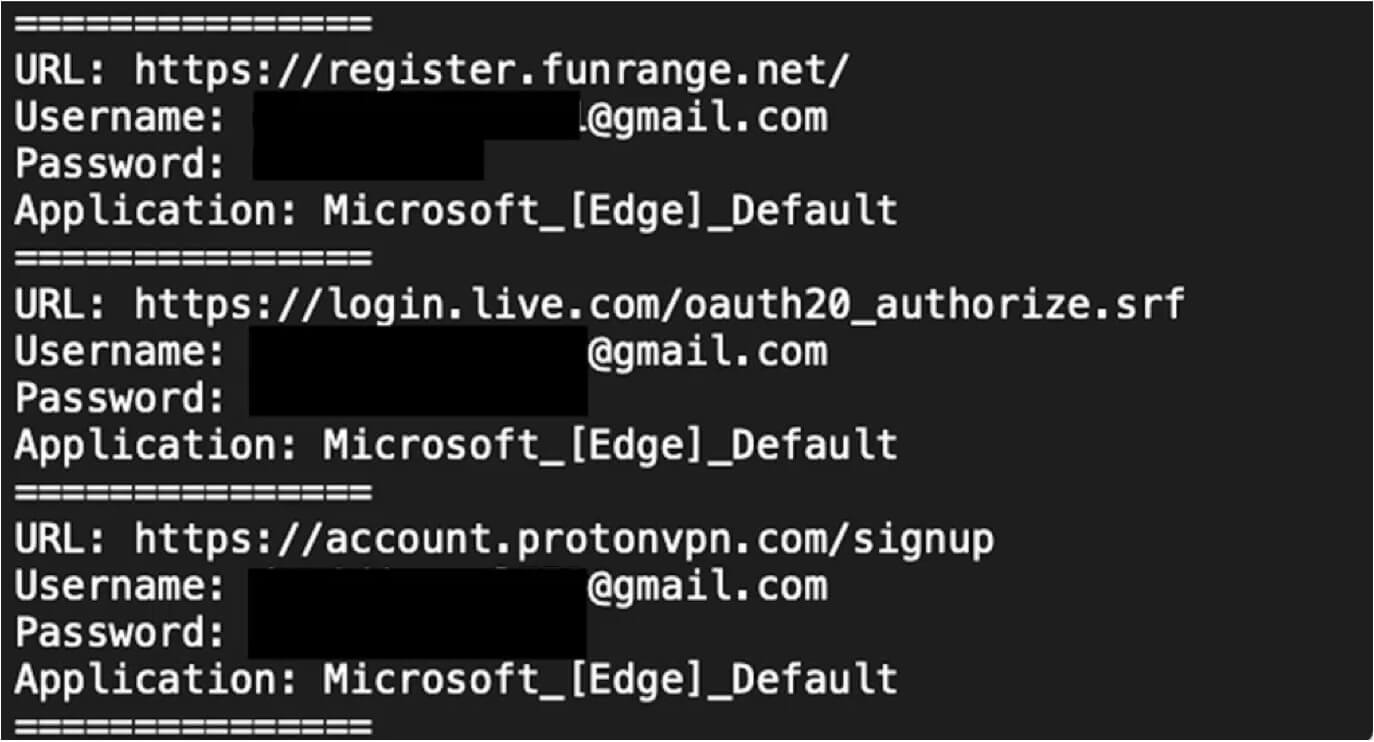
Redacted example of an infostealer log showing harvested login data, including URLs, usernames, password fields, and the browser application where the credentials were stored.
Those credentials are then packaged into logs and distributed through Dark Web marketplaces and other criminal channels, often becoming available within hours of being stolen.
The scale of this activity has grown dramatically. Billions of compromised credentials are now circulating online, including credentials associated with enterprise identity providers, cloud services, and business applications. Infostealer infections frequently expose far more than a single password, providing attackers with multiple opportunities to gain access to corporate environments.
As the ebook discusses, this has transformed credential exposure from an occasional security event into an ongoing operational challenge.
Organizations often think about identity security in terms of protecting corporate systems, but credential exposure frequently begins somewhere else.
Employees routinely use work email addresses to register for consumer websites, online retailers, collaboration tools, and SaaS applications. When one of those services experiences a data breach, the exposed credentials often become available to attackers regardless of whether the organization itself has been compromised.
If those same credentials are reused for business applications, attackers can simply test them against corporate login portals through credential stuffing attacks.
This means that a breach involving an unrelated third-party service can quickly become an enterprise security issue.
Password reuse continues to be one of the most persistent challenges in identity security because it extends organizational risk far beyond systems directly under an organization’s control. Combined with the rapid growth of infostealer malware, credential exposure has become both more frequent and more difficult to detect.
Modern IAM platforms provide critical capabilities for authenticating users, enforcing password requirements, managing access policies, and supporting compliance initiatives.
However, most were not designed to continuously determine whether a credential has appeared in newly discovered breach data, infostealer logs, or Dark Web intelligence.
A password that fully complies with an organization’s security policy today may become compromised tomorrow through an employee’s personal device, a third-party breach, or an infostealer infection. Unless organizations continuously evaluate credential exposure, they may have no indication that a trusted credential has become an active security risk.
This is where identity threat intelligence adds value.
Rather than replacing existing IAM investments, identity threat intelligence provides additional context by continuously evaluating credentials against current exposure data. When a compromised credential is identified, organizations can trigger automated response actions such as requiring a password reset, prompting additional authentication, or disabling an account based on organizational policy.
The result is an identity security strategy that reflects the current threat landscape rather than relying solely on controls applied when passwords are first created.
As identity-based attacks continue to evolve, organizations need to move beyond static password policies and periodic password checks.
The ebook outlines a practical framework for strengthening identity security by incorporating continuous credential monitoring into existing authentication workflows. It explores how organizations can improve Active Directory password protection, extend credential intelligence into IAM platforms and applications through APIs, and automate remediation when compromised credentials are detected.
Rather than requiring organizations to replace their identity infrastructure, this approach builds on existing investments by providing the visibility needed to identify credential exposure before attackers can exploit it.
Identity-first security isn’t about creating another layer of authentication. It’s about making better identity decisions using current threat intelligence.
Credential-based attacks continue to evolve, and organizations need security strategies that account for the reality that passwords can become compromised long after they’re created.
Our ebook, Identity-First Threat Intelligence: Harnessing Dark Web Signals to Strengthen IAM and AD Security, explores these topics in greater detail, including the rise of the infostealer economy, the impact of password reuse, the limitations of traditional IAM approaches, and practical guidance for incorporating continuous identity threat intelligence into Active Directory and modern authentication environments.
If you’re evaluating ways to strengthen your identity security strategy, download the complete ebook to learn how continuous monitoring for compromised credentials can help reduce identity risk before attackers gain access.