

Organizations have invested heavily in identity security. IAM, ITDR, MFA, passwordless methods, and other identity technologies add complexity, but address only parts of the credential-risk problem. Wherever passwords remain active, organizations still need purpose-built controls to identify and remediate exposure.
Despite these investments, compromised credentials continue to give attackers a direct path into enterprise systems and remain the most common initial access vectors in breaches.
New research from Cybersecurity Insiders, conducted with support from Enzoic, found a significant gap between how organizations view credential risk and how they address it.
While 85% of cybersecurity professionals consider compromised credentials a primary attack path into the enterprise, only 19% continuously monitor active credentials and automatically remediate exposure.
That 66-percentage-point gap is not primarily an awareness problem. Most organizations understand that compromised credentials create risk. The challenge is turning that awareness into an operating model capable of identifying exposed credentials while they are still active—and taking action before attackers can use them.
Many credential security programs concentrate their strongest controls at password creation or reset.
Organizations may enforce password requirements, block common or compromised passwords, and require MFA before granting access. These are largely point-in-time controls. They do not account for how credential risk can change after a password enters the environment.
A password that meets every security requirement when it is created may be exposed days, weeks, or months later. It could appear in a third-party data breach, be reused on another compromised service, or be captured by infostealer malware.
Once exposed, the credential may circulate outside the organization while remaining active and trusted within its identity environment.
The password may be unchanged, but its exposure status (and the risk of continuing to trust it) has changed.
This creates a timing problem. Traditional password controls often answer:
Was this password considered safe when it was created?
Modern credential defense must continue asking:
Is this active credential still safe to trust today?
The distinction matters because credential exposure can occur at any point during the life of an account.
Password screening at creation or reset helps prevent credentials already known to be compromised from entering the environment. However, that protection represents one point in a much longer credential lifecycle.
If a password becomes exposed after creation, a password policy alone cannot detect the change unless the credential is evaluated again. Waiting for the employee’s next password reset can leave the credential active during the period when it may be most useful to an attacker.
Routine password expiration alone does not solve this problem. Current NIST guidance emphasizes changing passwords when there is evidence of compromise rather than requiring arbitrary periodic changes. That approach depends on organizations having current intelligence about credential exposure.
Point-in-time screening answers whether a password was known to be compromised at a particular moment. Continuous monitoring helps determine whether an active credential remains safe after days, weeks, or months of use.
Continuous monitoring closes the lifecycle gap that point-in-time screening leaves behind.
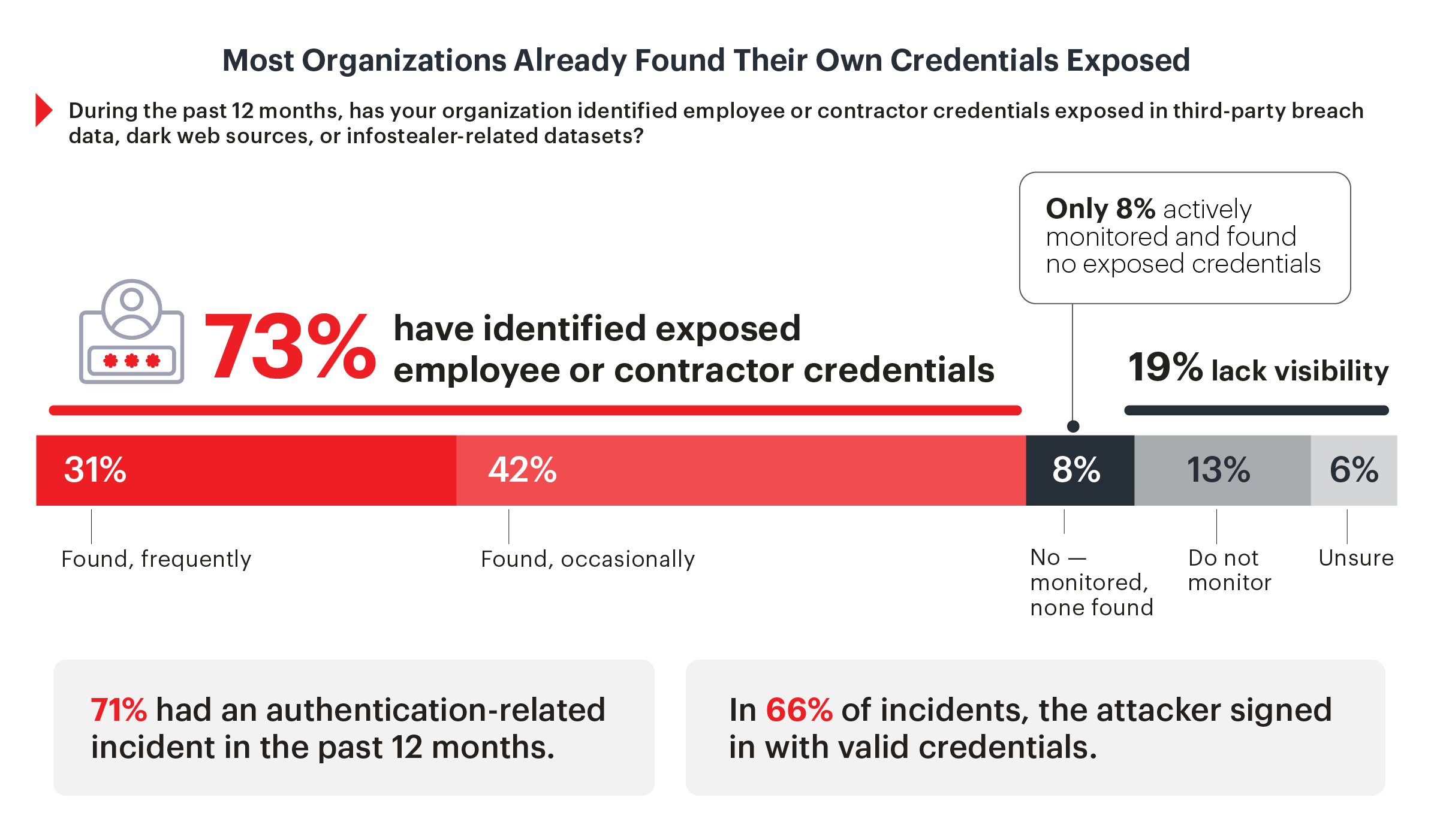
Credential exposure is not a hypothetical risk. According to the research, 73% of organizations identified employee or contractor credentials in third-party breach data, Dark Web sources, or infostealer logs during the past year.
When attackers exploit a software vulnerability, security tools may detect malicious files, unusual code, or other indicators of compromise.
Credential-based attacks can look different.
An attacker using a valid username and password may enter through the same authentication process used by an employee. The attacker does not necessarily need to break authentication. They may simply use information the organization still accepts.
This is why credential exposure should not be treated only as an external intelligence issue. Finding employee credentials in breach data, Dark Web sources, or infostealer logs is valuable only if organizations can connect that intelligence to the credentials and accounts currently granting access.
The goal is not simply to know that exposure exists. It is to determine whether the exposed information creates active risk and respond while there is still an opportunity to prevent misuse.
MFA can add friction to the use of a stolen password (and adds friction to legitimate logins as well), but it does not detect, remove, or remediate the exposed credential itself.
However, MFA does not make an exposed credential private again.
Passwords will remain the most common form of authentication for the foreseeable future, and will remain mandatory in part of many authentication environments, including legacy applications, hybrid infrastructure, recovery workflows, and password fallback processes. Organizations moving toward passwordless authentication may also continue supporting passwords during long transition periods.
Credential monitoring addresses the underlying exposure that MFA leaves in place.
MFA asks a user to provide additional proof during authentication. Credential monitoring asks whether the credential has appeared outside the organization’s control and should continue to be trusted.
MFA and other authentication controls should not be treated as substitutes for identifying and remediating credentials that have become exposed.
The same principle applies to broader identity investments. IAM governs access. ITDR helps identify identity-related threats and suspicious activity. Passwordless authentication, when passwords are not available as a backup authentication method, can reduce reliance on passwords. But organizations still need visibility into exposed credentials wherever passwords remain active.
Many organizations have access to breach data, Dark Web monitoring, security alerts, or other sources of threat intelligence. The larger challenge is turning those signals into timely action.
An alert that employee information has appeared in a breach may provide useful context. Security teams still need to determine whether the exposure includes a credential, whether it is associated with an active account, whether it remains in use, and what action should follow.
When these steps rely on separate tools and manual workflows, response takes longer. Each handoff can extend the period during which an exposed credential remains usable.
Credential intelligence becomes more valuable when it is integrated into the identity and authentication systems capable of acting on it. The objective is to reduce the time between credential exposure and containment—not simply identify that exposure occurred.
The findings in the 2026 Credential Risk Report point to the need for a broader operating model: Continuous Credential Defense.
Traditional password hygiene focuses primarily on password quality and user behavior. Continuous Credential Defense expands the focus to the ongoing integrity of active credentials.
This does not mean replacing existing identity controls. It means connecting credential exposure intelligence to the systems and workflows already responsible for authentication, access, and response.
A continuous approach requires organizations to evaluate credential risk beyond creation and reset, identify exposure while credentials are still active, and connect confirmed risk to timely remediation through automated or policy-driven action.
It also requires credential exposure to become an operational responsibility rather than simply another threat-intelligence feed. Visibility is valuable, but visibility without a clear response process can leave compromised credentials active after exposure is identified.
As credential-based attacks continue to evolve, the effectiveness of credential security will increasingly depend on how quickly organizations can move from intelligence to action.
Organizations are not ignoring credential risk. Most recognize that compromised credentials provide attackers with a viable path into enterprise environments, and many are investing in stronger identity and authentication controls.
The remaining challenge is closing the gap between recognizing exposure and operating a program capable of addressing it continuously.
Passwords can become compromised at any point in their lifecycle. Credential security must be able to identify that change without waiting for the next password reset, security incident, or successful attack. It must also translate confirmed exposure into prompt remediation.
The 2026 Credential Risk Report: From Password Hygiene to Continuous Credential Defense provides new research into how organizations are addressing credential exposure—and where significant gaps remain.
Download the full report to explore the findings, benchmark your organization’s credential-defense maturity, and learn what it takes to move from point-in-time password hygiene toward Continuous Credential Defense.